1. Could you tell us a little about yourself and your artistic journey?
My name is Giovanni D. I am a self-taught painter and artist, working primarily across painting, drawing, and sculpture. I was born in 2002, and for several years now I have been developing my practice with a focus on understanding what art can express when words are no longer enough.
My journey has been entirely self-taught. I did not follow a traditional artistic education; instead, I learned through experimentation, observation, making mistakes, and above all, painting extensively. This freedom has had a profound influence on the way I work. I do not seek to fit into a specific category, but rather to allow my artistic language to evolve alongside my experiences.
Over the years, I have had the opportunity to present my work in various exhibitions, including internationally. These experiences have made me realize that, despite cultural differences, an artwork can create an immediate connection between people who do not speak the same language.
Today, my journey is leading me toward an important new project: a solo exhibition in Seoul, South Korea, titled “Vibrations Between Two Worlds,” scheduled for October 2026.
2. How would you describe your artistic style and the main themes you explore in your work?
My work falls within the realm of lyrical abstraction. I am particularly drawn to texture, movement, contrasts, and anything that can suggest an emotion without representing it directly.
For a long time, I worked extensively around emotions, particularly our relationship with others and what we carry within ourselves. However, my work has evolved significantly in recent years.
A period of retreat and solitude led me to deeply reconsider the way I create. I began introducing much more emptiness and silence into my compositions, particularly through Chinese ink. Emptiness is no longer an absence; it becomes a living space, almost as important as the material itself.
Today, I could summarize this evolution through the idea of the “silence of what comes after” — that moment after the shock, after the emotion, when everything comes to a standstill for a few moments and we find ourselves face to face with ourselves.
I am therefore less interested in telling a story than in creating a space in which the viewer can project their own story.
3. What inspired you to create the artwork that received the Honorable Mention, and how has your experience with international exhibitions influenced your artistic journey?
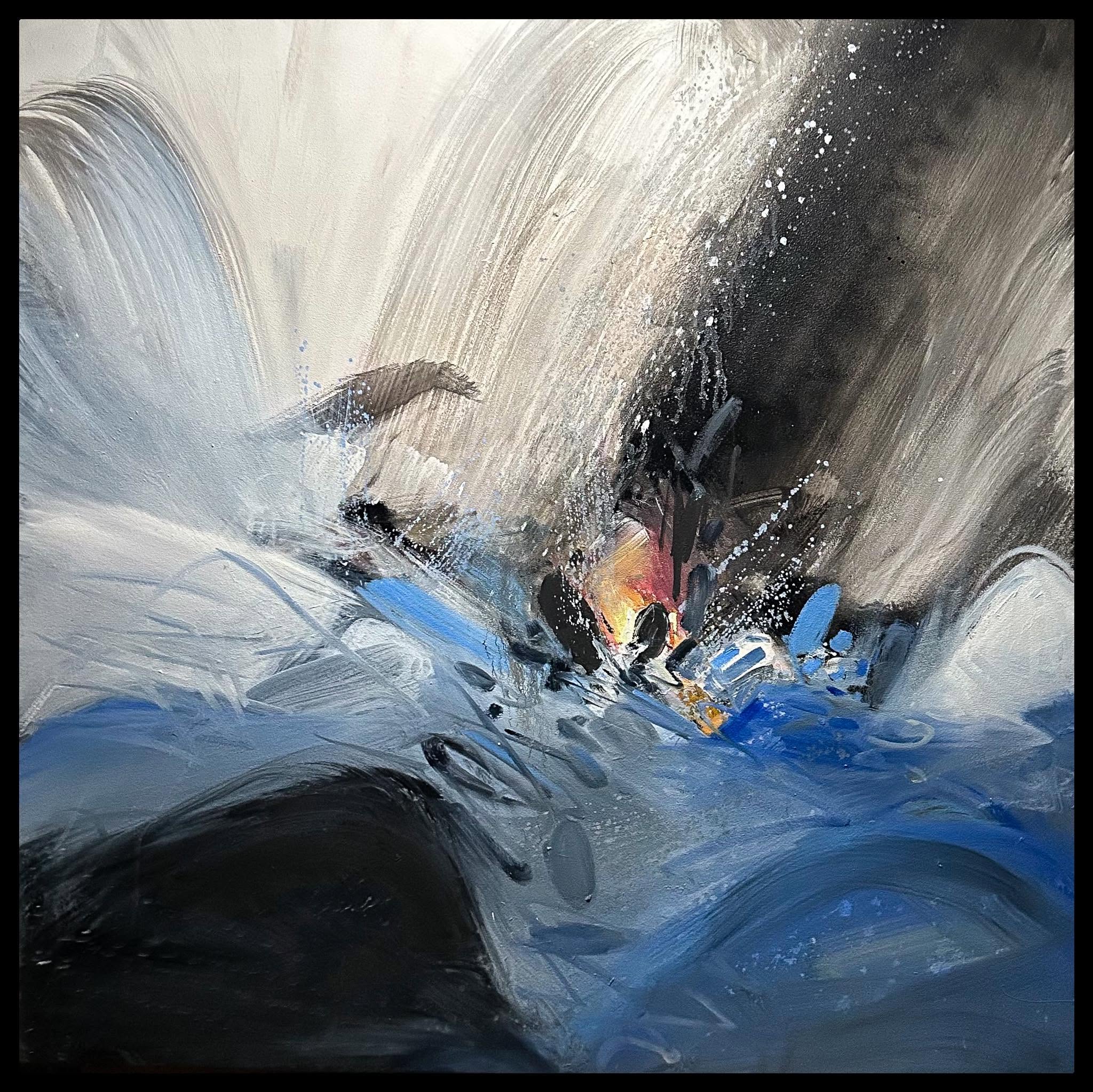
The artwork that received the Honorable Mention was born from a very instinctive process. I wanted to explore a sense of tension and movement by bringing very dark and red masses into dialogue with a much brighter, almost solar light at the center of the composition.
The painting gradually took shape through layers, gestures, erasures, and accidents. I was not trying to represent anything specific, but rather to convey a moment of confrontation: something seems to emerge, break apart, or transform within the material. For me, the contrast between the areas of light and the darker sections creates this sense of a turning point.
What interests me is precisely what can emerge during the process. A work can begin in one way and take a completely different direction as I continue working on it. I prefer to let the painting respond to me rather than trying to control everything.
This recognition was particularly important to me because it reinforced my belief that a self-taught artistic journey can find its place within an international art context.
My experiences abroad, particularly in Japan and now through my upcoming project in South Korea, have also changed the way I see my work. Exhibiting in another country forces you to step outside your usual environment and accept that your work will be viewed through different cultural references.
It is an incredibly enriching experience. You realize that art does not need to be fully explained in order to be felt. This is also what particularly attracts me to my project in Seoul: creating a dialogue between two cultures through something as universal as sensitivity.
4. What does your ideal workspace look like, and what helps you stay inspired during the long hours you dedicate to your work?
My ideal workspace would above all be a place where I can feel free, without feeling that I have to produce something. I need space, light, and above all, the ability to leave my works around me for several days.
I can work for long hours, but I do not necessarily try to paint all the time. There are moments when I simply look at a work, step away from it, and then return to it later. For me, the time spent not painting is also part of the work.
Silence has become particularly important in my creative process. I like working alone, listening to very little, and allowing my thoughts to settle. Music, nature, travel, encounters, and even periods of doubt can all become sources of inspiration.
Ultimately, I believe that what nourishes my work the most is life itself. I paint what I experience, even when I do not fully understand it yet.
5. What projects are you currently working on, and what would you like to explore in your future work?
My main project at the moment is my solo exhibition in Seoul, “Vibrations Between Two Worlds,” scheduled for October 2026. It is a very important step for me, as it represents both a new international opportunity and a continuation of my artistic evolution.
I am currently working on new pieces that continue this exploration of movement, silence, and emptiness. Chinese ink is playing an increasingly important role in my practice, allowing me to explore a more stripped-back and spontaneous form of expression.
I would also like to continue developing the dialogue between painting, drawing, and sculpture, and perhaps explore installation art more deeply.
In the long term, above all, I want to preserve this freedom to experiment. I do not want to try to reproduce what already works. I want to continue surprising myself.
I believe that an artist’s journey is never truly finished. Each artwork allows you to understand something, only to question that understanding again. It is precisely this ongoing search that continues to make me want to create.
Published by New Road 2 Art Editorial Team
🇫🇷 Original Interview in French
1. Pourriez-vous nous parler un peu de vous et de votre parcours artistique ?
Je m’appelle Giovanni.D, je suis artiste peintre autodidacte et je travaille principalement autour de la peinture, du dessin et de la sculpture. Je suis né en 2002 et je développe mon travail depuis plusieurs années en cherchant avant tout à comprendre ce que l’art peut permettre d’exprimer lorsque les mots ne suffisent plus.
Mon parcours est entièrement autodidacte. Je n’ai pas suivi de formation artistique classique : j’ai appris en expérimentant, en observant, en faisant des erreurs et surtout en peignant énormément. Cette liberté a profondément influencé ma manière de travailler. Je ne cherche pas à entrer dans une catégorie précise, mais plutôt à laisser mon langage artistique évoluer avec mes expériences.
Au fil des années, j’ai eu l’occasion de présenter mon travail dans différentes expositions, notamment à l’international. Ces expériences m’ont permis de comprendre que, malgré les différences culturelles, une œuvre peut créer une rencontre immédiate entre des personnes qui ne parlent pas la même langue.
Aujourd’hui, mon parcours me conduit notamment vers un nouveau projet important : une exposition personnelle à Séoul, en Corée du Sud, intitulée « Vibrations entre deux mondes », prévue en octobre 2026.
2. Comment décririez-vous votre style artistique et les principaux thèmes que vous explorez dans votre travail ?
Mon travail se situe dans une abstraction lyrique. Je suis particulièrement attiré par la matière, le mouvement, les contrastes et tout ce qui peut suggérer une émotion sans la représenter directement.
Pendant longtemps, j’ai beaucoup travaillé autour des sentiments, notamment de la relation à l’autre et de ce que nous portons intérieurement. Mon travail a cependant évolué récemment.
Une période de retraite et de solitude m’a amené à repenser profondément ma manière de créer. J’ai commencé à introduire beaucoup plus de vide et de silence dans mes compositions, notamment à travers l’encre de Chine. Le vide n’est alors plus une absence : il devient un espace vivant, presque aussi important que la matière elle-même.
Je pourrais aujourd’hui résumer cette évolution par l’idée du « silence de l’après » : ce moment qui existe après le choc, après l’émotion, lorsque tout s’arrête quelques instants et que l’on se retrouve face à soi-même. Je cherche donc moins à raconter une histoire qu’à créer un espace dans lequel le spectateur puisse projeter sa propre histoire.
3. Qu’est-ce qui vous a inspiré pour créer l’œuvre qui a reçu la Mention Honorable, et comment votre expérience des expositions internationales a-t-elle influencé votre parcours artistique ?
L’œuvre qui a reçu la Mention Honorable est née d’une démarche très instinctive. Je voulais travailler autour d’une sensation de tension et de mouvement, en faisant dialoguer des masses très sombres et rouges avec une lumière beaucoup plus vive, presque solaire, au centre de la composition.
Le tableau s’est construit progressivement, par superpositions, gestes, effacements et accidents. Je ne cherchais pas à représenter quelque chose de précis, mais plutôt à faire ressentir un moment de confrontation : quelque chose semble émerger, se briser ou se transformer au cœur de la matière. Le contraste entre les zones de lumière et les parties plus sombres crée pour moi cette impression de basculement.
Ce qui m’intéresse, c’est précisément ce qui peut apparaître pendant le processus. Une œuvre peut commencer d’une manière et prendre une direction complètement différente au fur et à mesure que je travaille dessus. Je préfère laisser la peinture me répondre plutôt que de vouloir tout contrôler.
Cette reconnaissance a été particulièrement importante pour moi parce qu’elle m’a conforté dans l’idée que mon parcours autodidacte pouvait trouver sa place dans un contexte artistique international.
Mes expériences à l’étranger, notamment au Japon et aujourd’hui avec mon projet en Corée du Sud, ont également changé mon regard. Exposer dans un autre pays oblige à sortir de son environnement habituel et à accepter que l’œuvre soit regardée avec d’autres références culturelles.
C’est une expérience très enrichissante : on comprend que l’art n’a pas besoin d’être entièrement expliqué pour être ressenti. C’est aussi ce qui m’attire particulièrement dans mon projet à Séoul : créer un dialogue entre deux cultures à travers quelque chose d’aussi universel que la sensibilité.
4. À quoi ressemble votre espace de travail idéal, et qu’est-ce qui vous permet de rester inspiré pendant les longues heures consacrées à votre travail ?
Mon espace de travail idéal serait avant tout un endroit où je peux être libre, sans avoir l’impression de devoir produire quelque chose. J’ai besoin d’espace, de lumière et surtout de pouvoir laisser les œuvres autour de moi pendant plusieurs jours.
Je peux travailler pendant de longues heures, mais je ne cherche pas forcément à peindre en permanence. Il y a des moments où je regarde simplement une œuvre, où je m’éloigne, où je reviens dessus. Pour moi, le temps passé à ne pas peindre fait aussi partie du travail.
Le silence est devenu particulièrement important dans mon processus créatif. J’aime travailler seul, écouter peu de choses et laisser les pensées se calmer. La musique, la nature, les voyages, les rencontres et même les périodes de doute peuvent devenir des sources d’inspiration.
Je crois finalement que ce qui nourrit le plus mon travail reste la vie elle-même. Je peins ce que je traverse, même lorsque je ne le comprends pas encore complètement.
5. Sur quels projets travaillez-vous actuellement et qu’aimeriez-vous explorer dans vos futurs travaux ?
Mon projet principal actuellement est mon exposition personnelle à Séoul, « Vibrations entre deux mondes », prévue en octobre 2026. C’est une étape très importante pour moi, car elle représente à la fois une nouvelle ouverture internationale et une continuité dans mon évolution artistique.
Je travaille actuellement sur de nouvelles œuvres qui prolongent cette recherche autour du mouvement, du silence et du vide. L’encre de Chine occupe une place de plus en plus importante dans mon travail et me permet d’explorer une écriture plus dépouillée, plus spontanée.
J’aimerais également continuer à développer le dialogue entre peinture, dessin et sculpture, et pourquoi pas travailler davantage autour de l’installation.
À plus long terme, je souhaite surtout conserver cette liberté d’expérimentation. Je ne veux pas chercher à reproduire ce qui fonctionne déjà. J’ai envie de continuer à me surprendre moi-même.
Je pense que le parcours d’un artiste n’est jamais réellement terminé. Chaque œuvre permet de comprendre quelque chose, puis de remettre cette compréhension en question. C’est précisément cette recherche qui me donne encore envie de créer.